PHOENIX INDIAN CENTER
Cultural Enrichment

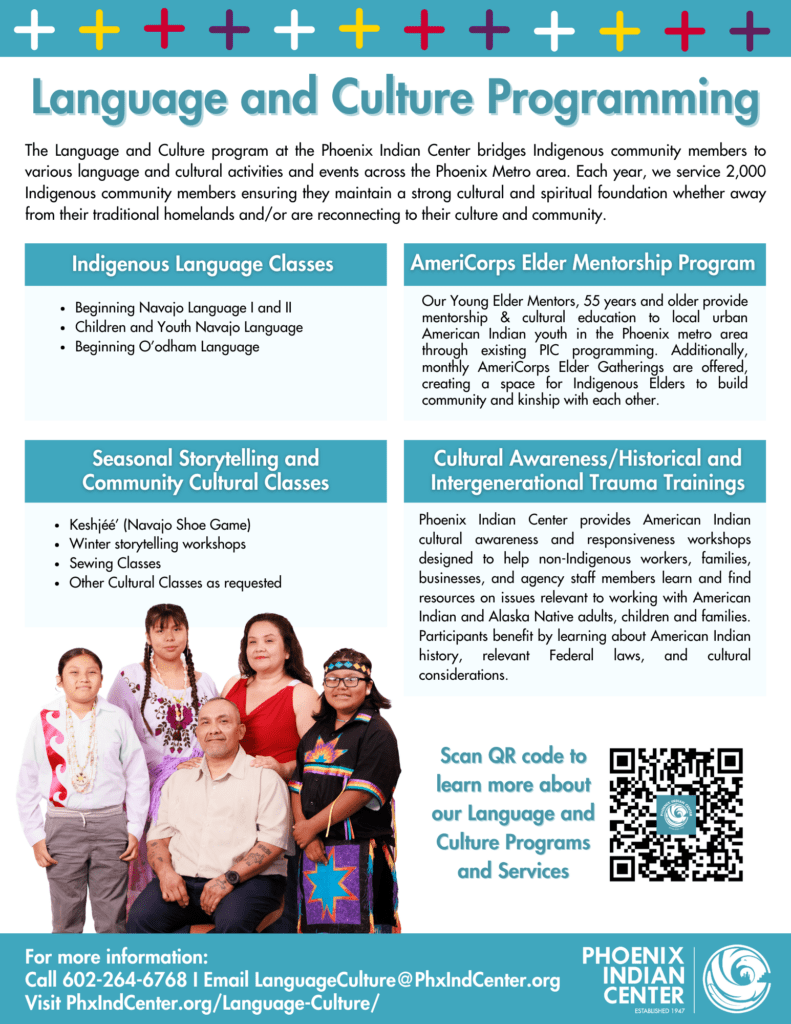
We believe in the importance of ensuring the revitalization of our Native languages, and that our culture and traditions continue to pass on to the next generations. We have several Native language experts on staff and we contract with others to provide classes, workshops and events to the community. We have experts in cultural awareness to provide workshops and training for groups and organizations looking to embrace cultural diversity.

Check out our upcoming events! For questions about workshops call 602-264-6768. 

UPCOMING WORKSHOPS, CLASSES & PROGRAMS
Check Out What's Happening

Yá’át’ééh / Ha’u / Ske:g taṣ / Ti un Sengi / Aŋpétu Wašté / Hoat (Greetings)! The Phoenix Indian Center Language and Culture department is proud to offer free community-based Indigenous language courses that cover the basics of language syntax, common use phrases, along with culturally relevant stories and teachings. . Classes are funded by the Administration for Native Americans grant. This website is supported by Grant Number 90NL0701 from the Administration for Native Americans the Administration for Children and Families, a division of the U.S. Department of Health and Human Services. Neither the Administration for Children and Families nor any of its components operate, control, are responsible for, or necessarily endorse this website (including, without limitation, its content, technical infrastructure, and policies, and any services or tools provided). The opinions, findings, conclusions, and recommendations expressed are those of the author(s) and do not necessarily reflect the views of the Administration for Children and Families and the Administration for Native Americans.

Children and Youth Navajo Language Classes

The Phoenix Indian Center is hosting a summer session starting on Tuesday, July 7th.
Youth (0-17 years of age) are welcome to register for this 4-week course!
Classes will be held twice a week on Tuesday & Thursdays via Zoom from 4:00pm to 5:00pm (PHX Time). The instructor for this series is Geneva Johnson.


Parents and guardians, register your children today! Limited seats available.

For more information, contact the Language & Culture Specialist, Melina Yellowhair myellowhair@phxindcenter.org or 602-264-6768.

Beginning Navajo II with Kevin Belin (May 11 – June 11, 2026)

Limited virtual seats are available.

To register for this online class, contact  Language & Culture Specialist, Melina Yellowhair at myellowhair@phxindcenter.org

This website is supported by Grant Number 90NL0701 from the Administration for Native Americans the Administration for Children and Families, a division of the U.S. Department of Health and Human Services. Neither the Administration for Children and Families nor any of its components operate, control, are responsible for, or necessarily endorse this website (including, without limitation, its content, technical infrastructure, and policies, and any services or tools provided). The opinions, findings, conclusions, and recommendations expressed are those of the author(s) and do not necessarily reflect the views of the Administration for Children and Families and the Administration for Native Americans.

There are no upcoming cultural events at this time.

For inquires, contact the Language & Culture team at languageculture@phxindcenter.org 602-264-6768.

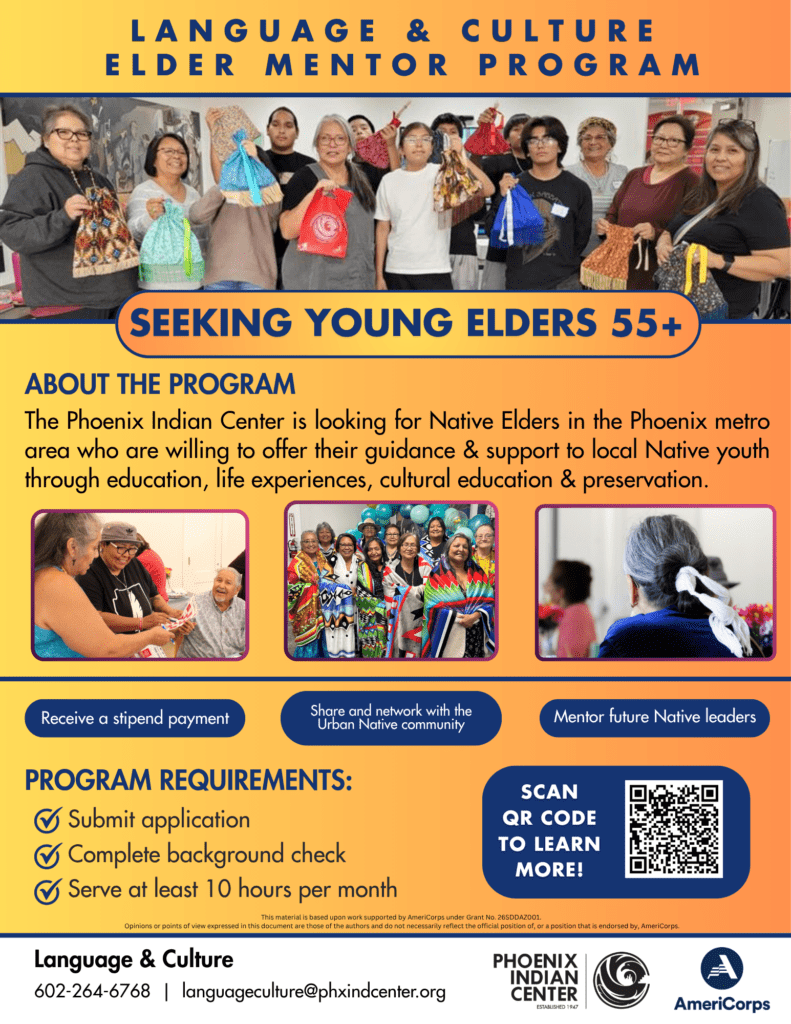
The Phoenix Indian Center is recruiting Young Elders (ages 55+) from across the Phoenix Metro area to share their wisdom, lived experience, cultural knowledge, traditional teachings, and mentorship with local Indigenous youth. Young Elders play an important role in strengthening intergenerational relationships, preserving cultural traditions, and helping Native youth build a stronger connection to their identity, culture, and community.


Through the program, Young Elders may participate in cultural workshops, storytelling, language revitalization efforts, community events, and mentorship opportunities that support the well-being and growth of Indigenous youth.

Eligibility Requirements

To participate in the AmeriCorps Young Elder Program, applicants must:

  1. Be 55 years of age or older
  2. Participate in an interview with program staff
  3. Successfully pass a criminal background check.
  4. Commit to serving a minimum of 10 hours per month

Click here to complete an application online, or submit the attached application form.

If you are interested in sharing your knowledge, experiences, and teachings with the next generation, we encourage you to apply and become part of this meaningful intergenerational initiative.

For additional information, please contact the Phoenix Indian Center.

Elder Gatherings will resume in August 2026. For more information on Elder programming contact the Language & Culture team at languageculture@phxindcenter.org 602-264-6768.

This program is available to all without regard to race, color, national origin, sex, age, religion, sexual orientation, disability (mental or physical), gender identity or expression, political affiliation, marital or parental status, pregnancy, genetic information (including family medical history), military service, or their submission of a complaint. Compliance information and/or history can be requested from Elicia Goodsoldier, Language and Culture Manager at egoodsoldier@phxindcenter.org or by calling 602-264-6768.

Service members, volunteers, employees, and applicants for Federal employment who wish to file a discrimination complaint may do so by sending an email message to eo@AmeriCorps.gov or by leaving a voice message on the Civil Rights Hotline at 1-202-606-3461. Calls to the hotline will be returned within 24 hours.

You can learn more information at: https://americorps.gov/about/agency-overview/civil-rights

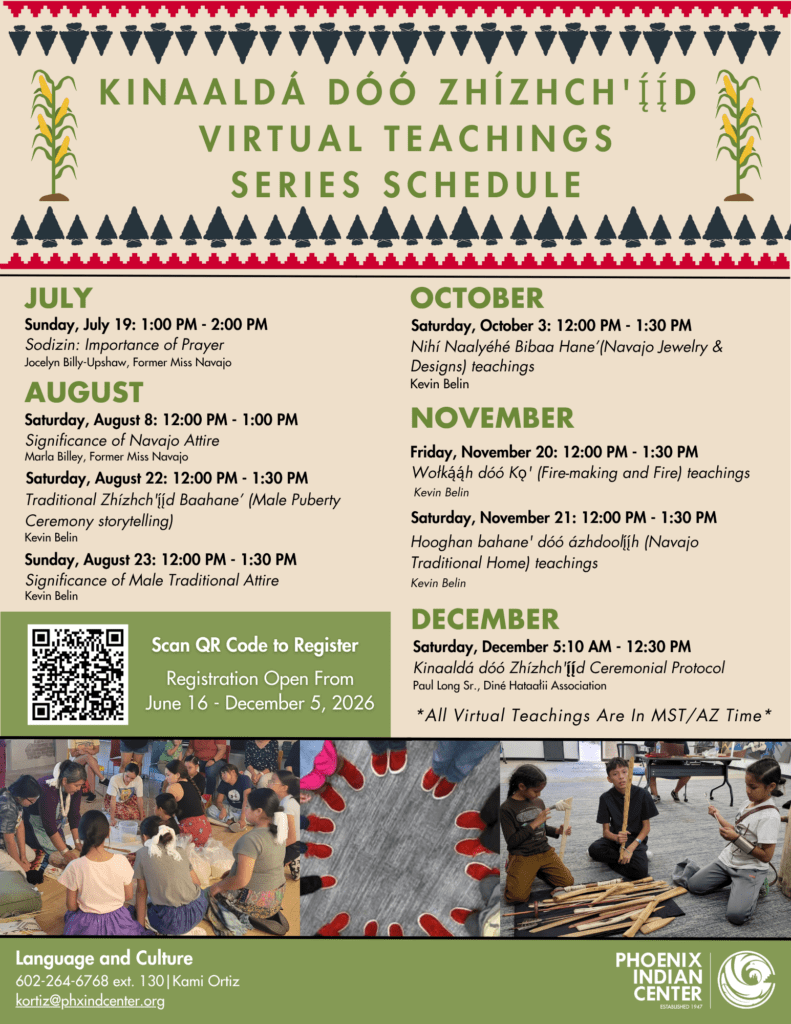
Kinaaldá (Female) and Zhízhch’į́į́d (Male) Navajo Coming of Age Virtual Teachings Series

We invite relatives to register for a virtual teaching series that will focus traditional teachings interwoven in the Navajo Kinaaldá (female) and Zhízhch’į́į́d (male) puberty ceremonies. We invite youth, parents, aunties, uncles, mentors, and elders near and far to tune in to listen to cultural sharings from various Knowledge Keepers.

This virtual series will take place from July to December 2026.
These teachings will NOT be recorded. All times in AZ standard time.

  1. Sodizin: Importance of Prayer with Jocelyn Billy-Upshaw, Former Miss Navajo
    Saturday, July 18   |   2:00 PM – 1:00 PM
  2. Significance of Navajo Attire with Marla Billey, Former Miss Navajo
    Saturday, August 8   |   12:00 PM – 1:00 PM
  3. Traditional Zhízhch’į́į́d Baahane’ (Male Puberty Ceremony storytelling) with Kevin Belin
    Saturday, August 22   |   12:00 PM – 1:30 PM
  4. Significance of Male Traditional Attire with Kevin Belin
    Sunday, August 23   |   12:00 PM – 1:30 PM
  5. Nihí Naalyéhé Bibaa Hane’(Navajo Jewelry & Designs) teachings with Kevin Belin
    Saturday, October 3   |   12:00 PM – 1:30 PM
  6. Wołką́ą́h dóó Kǫ’ (Fire-making and Fire) teachings with Kevin Belin
    Friday, November 20   |   12:00 PM – 1:30 PM
  7. Hooghan bahane’ dóó ázhdoolį́į́h (Navajo Traditional Home) teachings with Kevin Belin
    Saturday, November 21   |   12:00 PM – 1:30 PM
  8. Ceremonial Protocol with Paul Long Sr., Diné Hataałii Association
    Saturday, December 5   |   10:00 AM – 12:30 PM

We acknowledge that teaching might differ from what some relatives know or have been taught. We are all learners, so please be kind and open-minded. Join us online for this opportunity to learn about the teachings and stories surrounding the Navajo male and female puberty ceremonies.

Register today: Click Here!

For more information, contact the Language & Culture Coordinator, Kami Ortiz kortiz@phxindcenter.org or 602-264-6768.

About the American Indian Cultural Awareness and Understanding Historical and Intergenerational Trauma Workshops & Trainings:

The Phoenix Indian Center offers American Indian cultural awareness and responsiveness training and workshops for departments, agencies, businesses, and schools. Trainings and workshops are designed to help non-Indigenous workers, families, business and agency staff members learn and find resources on issues relevant to working with American Indian and Alaska Native adults, children and families. This also includes an in-depth look at Understanding Historical and Intergenerational Trauma in Indigenous Communities. Participants will benefit by learning:

Cultural Awareness

  1. Overview 22 tribes in AZ
  2. Discuss appropriate terminology
  3. Local, state and national data, information and statistics
  4. Cultural considerations and values
  5. Appreciation vs. Appropriation
  6. Historical and intergenerational trauma and risks
  7. Role and impact of mainstream media
  8. Discuss cultural identity (Urban vs Rural Considerations)
  9. Explore cultural resiliency and strategies

Historical and Intergenerational Trauma

  1. Understanding Trauma-Informed care
  2. Communities Impacted by Historical Trauma
  3. Impacts of Federal Indian Policy
  4. Adverse Childhood Experiences (ACE’s)
  5. Cultural Resiliency
  6. Strategies for Support

We offer 1 hour, 2 hour or 3-hour presentations based on requestors’ need.

To best gauge your trainings needs, we request that you fill out the following form with as much information as possible. We will contact you within 48 hours to schedule a follow-up meeting. Requests must be made no less than 3 weeks prior to your requested date with the exception of November dates. We receive many requests for training conducted in November which is designated as American Indian Heritage Month therefore, we are requesting no less than 6 weeks advance notice.

To request a training session, click here 

For more information, you may contact:

Elicia Goodsoldier, Language and Culture Program Manager

egoodsoldier@phxindcenter.org or LanguageCulture@phxindcenter.org

Phoenix Indian Center: (602) 264-6768 ext. 118


Boys With Braids

The significance of having long hair is sacred amongst all American Indians. It connects us to our cultural identity, our spirituality and our ancestors. While all tribes are different and have varying stories and traditions about what having long hair signifies, they have teachings and a cultural connection. Long hair promotes self-esteem, self-respect, and pride. Long hair is a form of self expression that reinforces a connection to one’s family, tribe, community and traditions. Click here to download the Boys with Braids resource sheet for teachers.

a 501(c) 3 non-profit recognized by the IRS. Tax ID Number: 86-6006566